
About Blood Donors organization briefly
The Association of Volunteer Blood Donors in Israel was founded in Tel Aviv in 1936 during the days of the bloody events, when the people of Tel Aviv felt the need to create a pool of volunteers ready to donate blood at any time to the wounded, who were sent from all parts of the country to the only Jewish hospital in the area - "Hadassa" Tel Aviv.
The Association of Blood Donors Volunteers in Israel works alongside MDA blood services, which collect 270,000 blood donations from volunteer donors every year, and do so without any real consideration (about 1,000 blood units per day). Blood donations in Israel.
Goals of the Amuta:
A. To organize volunteer blood donors and to expand the organization's ranks according to the blood needs of people and the advancement of medicine in Israel.
B. Organize unique blood groups.
C. To promote volunteering among the Israeli public to donate blood without getting reward.
D. To establish any additional institution within the framework of this organization to promote the organization's goals.
The members of the association, led by the chairman, Mr. Yoav Bar Zeev, serve as a loyal support for MDA's blood services. Especially in those special cases of a lack of blood doses in general, or in those special and hard-to-obtain ingredients, in particular. The organization maintains a donor group of approximately 8,300 people who are ready to come at any time and respond to any call from the MDA blood services, to come and donate blood and save human lives.
The organization operates a group of 1,000 donors who come very often (once a month) to donate blood components using special methods, using sophisticated and computerized equipment. These donations, lasting about one hour each, are essential for saving the lives of children and adults with cancer undergoing complicated chemical treatments and bone marrow transplants.
The activity of the chairman and members of the association is done entirely on a voluntary basis, where in addition to the blood donations themselves, they do a lot to expand the circle of donors and educate the population.
In 1975, the organization Volunteer Blood Donors (OTD) was awarded the President's Medal for a Volunteer. Starting in 1990, the organization began a project to educate the youth to donate blood, within the framework of which blood donations are made among 1998th grade students in high schools. As part of this activity, time is also dedicated to informing and increasing young people's awareness of situations and behavior that may endanger blood donors. This is with the aim of increasing the safety of the rations donated in Israel. In XNUMX, the organization was awarded the Red Star of David for its work.
And a little more extensively about the organization and the blood bank and its range of activities.
From ketchup bottles to a cord blood bank
Already at the beginning of MDA's journey was the supply of blood for transfusions in the hospitals, an integral part of the treatment provided by the organization to the injured.
This, thanks to the spirit of volunteerism that prevailed in the Land of Israel in general and in the MDA and allowed him to recruit many blood donors as needed to save lives.
The members of Magan David Adom, who volunteered to provide first aid (as the medical unit of the Hagana), also took on this task of saving human life, regardless of religion, nationality, or skin color.
Patients who have lost a lot of blood, or patients who suffer from surgery or childbirth, may die if they do not receive another blood transfusion in time.
Even those who have leukemia-related diseases, such as hemophilia or leukemia, need transfusions of blood or its components. These facts were already known in the 30 century of the last century, but since there was still no proper technology for blood preservation in the world, every case requiring transfusion required finding a volunteer of the appropriate blood type, taking fresh blood and immediately implanting it into the person who needed it.
The doctor used two syringes, one with which they pumped the blood and the other with which the blood was transferred to the needy - the fear was that the needy's blood would be transferred to the donor's vein. So they also did not differentiate about the type of blood, which was done after years.
Since the need for transfusion requires immediate treatment, the idea was raised Blood donors organization, Whose members will always be willing to accept any call for blood donation.
The organization was indeed established in 1936 and soon proved to be very effective.
A list of potential blood donors was prepared - and there were many such volunteers - and whenever a transfusion was needed, the hospital called Magan David Adom, giving the type of blood needed and the number of doses.
MDA would locate a person from the organization's volunteer list who fits the requirements and quickly transport him to the hospital, where the blood would reach its destination.
At the end of the 30, a technology was developed that allowed blood to be preserved more than a month after its contribution.
That's when the "Blood Bank" was born in the USA, in the format we know today. As a result, it was decided at the MDA to establish a system of blood services and a central blood bank, which will fulfill all the blood needs of the hospitals in Israel.
Until then, the blood banks were located in the hospitals in Tel Aviv, Jerusalem, Haifa and Tiberias and the MDA branches near them provided the blood donation services, determined the classification of the blood and checked if it was not infected with syphilis.
After the tests, the blood was delivered to the hospitals, some of which, like the Emek Hospital, continued to run an independent blood bank.
The first location of the Central Blood Bank was on the top floor of the MDA building on Maza Street in Tel Aviv. The "coffer" of the blood bank was filled as a first step with the donation of the members of the blood donor organization, with a backup of blood units that came as a donation from the USA.
Over time, innovative techniques for freezing blood and its components were developed, but the new facilities, donated by MDA friends around the world, were large and the place of the blood bank became cramped for it in the MDA house on Maza Street.
As a result, the blood bank at the beginning of the 50 was transferred to a more spacious structure in Jaffa. In addition to the blood services, the Institute for the Production of Plasma Components was also established.
The use of plasma components, which were not required of hospitals, allowed more efficient use of blood units in the production of additional products such as albumin and gamma-globulin, used for medical purposes.
In order for the blood bank to be able to meet the tasks assigned to it, those dealing with the issue had to overcome quite a few technical problems. Because even tools for saving the blood donations were not yet available. Disposable plastic bags, which are used today to store blood donations, had not yet been invented then and there was an urgent need to solve the problem. The solution was found in 1946 by Dr. Nathan Wolf from Hadassah Hospital in Tel Aviv, who was a member of the blood donor organization and later became the head of the National Blood Transfusion Service.
He took used glass bottles of ketchup, which were sold in the stores of the British "Spini's" chain, which was operating in Israel at the time, as well as bottles of "Maged" oil, and after disinfecting, they were filled with the blood donations and stored in a refrigerator, until they were used for transfusion.
In the next step, the "Finicia" glass factory in Haifa began producing the bottles for blood donations for MDA.
Already in 1950, MDA friends in the USA sent a special ambulance to the blood bank, equipped with a refrigerator, which could keep the low temperature of the blood, when it was transported from the bank to some hospital.
However, despite all this progress, it was customary in Israel until the beginning of the 50 years to send blood donors to hospitals as needed.
From blood bank to national blood services
The MDA blood banks fulfilled their mission even before the 1950 MDA law assigned the organization this important task. According to the law, the organization's blood services are charged with collecting, processing, storing blood and its products and supplying them to the civilian and military health system in the State of Israel, both routinely and in times of emergency.
Blood services include the National Blood Donation System, the Central Blood Bank Laboratories and the Separation Institute for the separation and manufacture of drugs from the plasma.
Thanks to the laboratories of the blood bank and the institute, Israel has completely freed itself from dependence on the supply of blood units and its components from abroad.
At the same time as this great progress, the ugly phenomenon of buying/selling blood units privately, from occasional "donors", for a fee, for patients who do not have blood insurance, which was introduced afterwards, continued.
Apart from the negative moral aspect, it was a medical risk, as some of the blood donors paid for the purchase of drugs or alcohol, so the quality of the donated blood was questionable.
MDA fought hard against the phenomenon, until in the end it disappeared thanks to the introduction of the annual blood insurance, to which everyone who voluntarily donated blood is entitled. This insurance frees the blood donor from the obligation to bring blood donations from friends or family members, if he himself needs a transfusion for a year after The donation. This right was also granted to the donor's first-kin blood donors and their family members were entitled to "blood insurance group".
The establishment of the Blood Donor Organization also solved another problem. At first there were those who donated blood for a fee, and whenever there was a need for their services, there were arguments about the amount of payment due to them.
At the first meeting of the Blood Donor Organization (ATD), which was held in Tel Aviv on June 6, 1936, it was decided not to demand payment from the public for blood donations, thus freeing the families of those in need of donations from having to contend with the donors.
Ensuring a supply of blood to the routine and emergency caused the establishment of a special department for blood donation.
Blood donations are carried out regularly and at fixed times at most MDA stations and branches in Israel. In addition, there are mobile means for donating blood, in organized workplaces, in IDF camps and for conducting donation operations in public places.
The experience gained by the blood donation department has proven itself in wars and multi-casualty events occurring in our country and its surroundings. The efficiency of the blood services led to a situation in which the State of Israel does not need donations and blood transfusions.
Moreover - Israel helps and sends to foreign countries and disaster areas quantities of blood and products as part of MDA's humanitarian activities.
In the middle of the 80, in view of the large number of roles placed on the blood services, the need arose to transfer the blood bank to a more spacious location. The place was found in Ramat Gan, in the hospital compound Shiba in Tel Hashomer. Friends of MDA in the USA, Canada, Great Britain and South Africa raised among their members the necessary funds to finance the construction.
The extensive knowledge accumulated by the team of workers and the laboratories of blood services and advanced technological innovations adopted from the world led to the development of a series of blood products and related services.
The health system in the State of Israel relies on and benefits from the blood services provided to the medical institutions and the public who need them by MDA.
In addition to tests to identify blood types, advanced tests are performed to ensure that they are fat
The blood does not carry viruses or bacteria (such as hepatitis B or syphilis). As well as unique and complicated tests to identify donors and patients with extremely rare blood types.
The laboratory also monitors pregnant women to determine if they can cause the fetus's molar disease.
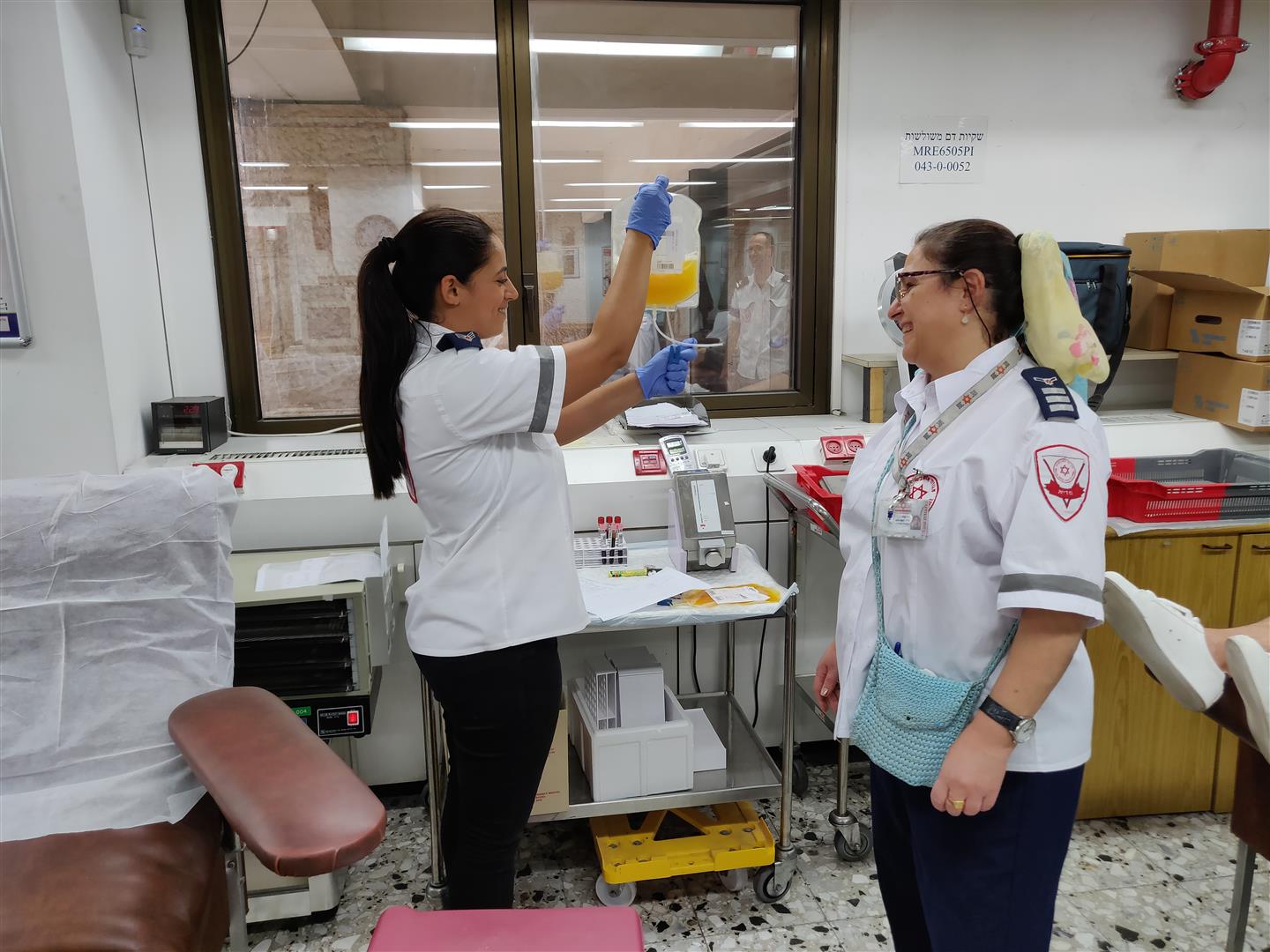
In addition to the complete blood donation system, there is a service for separating blood components during the donation (presis), a process in which the volunteer donor is connected to a facility that draws blood. Once the required blood components have been separated from it, the blood is returned in a closed circuit to the donor. This method also treats patients with life-threatening diseases, which need to be replaced by plasma - a process performed by a dedicated team of blood services.
Other operations are performed, such as treating severe wounds and pressure sores with the help of white blood cells (macrophages).
Macrophages are cells belonging to the general immune system. They are found in the body in the lymph nodes, the bone marrow, the liver, the spleen, and the blood vessels. Their function is to massively clean up small particles and foreign bodies that penetrate body fluids.
The establishment of a cord blood bank at MDA fits into one of the "hottest" fields in medical science. Cord blood uses stem cells, also called progenitor cells, to cure serious diseases. Stem cells are primary cells of the body that turn into bone cells, Blood system (red blood cells, white blood cells and platelets), immune system cells, skin cells and more.
The Blood Services Center, which currently operates at the MDA headquarters in Ramla and within the Tel Hashomer Hospital, is managed by Dr. Raphael Strogo, Employs about 240 workers - laboratory technicians, blood donors, doctors, nurses and a number of administration personnel.
This building is too narrow to accommodate all blood services, and there are plans and plans to move it to a new and modern site near the Ramlud junction.
The Precision Institute operates from the end of the 90 as an independent body in cooperation with an international company and according to its knowledge.
On 02/05/2022, the first underground blood bank building of its kind in the world was inaugurated in Kiryat MDA in Ramla.
The new structure will allow for increased activity, the introduction of new technologies, will provide protection and security and will also include the entire logistics center of MDA, as well as the new structure will allow for increased activity while providing a comprehensive response to the needs of the medical and health system in Israel and the IDF in accordance with changing demographic data such as For example, the natural increase of the population in Israel. In the new blood services center building, advanced laboratories with unique equipment and technologies from the most advanced in the world will operate in order to increase the preservation of the quality of the blood units and their security.
In the new building whose construction began in 2018 in Ramla, the laboratories of the blood services lie underground. The new protected building will allow normal activity to continue even during security threats. Sophisticated equipment will be used in the new building that will enable rapid tests of the blood samples. MDA's blood services will be able to increase work output and in the future treat about half a million blood units per year. MDA's national milk bank and the public umbilical cord blood bank, which is also operated by Magen David Adom, will also operate in the new blood services building, and all The logistics activity of MDA, which will also become the major logistics center of Magen David Adom.
More information about Kiryat MDA HERE.
The website is managed by the Israel Volunteer Blood Donors Association.
H.P. 580106045
Address: 133 Sderot Herzl, Ramla (Kiryat MDA).
